
Learn

- Share:
-

-

-

-


Currency Outlook Fourth Quarter 2025
By David Grimaldi, Foreign Exchange Sales Consultant
The Federal Reserve Board cut interest rates by 25 basis points (BP) this week with only one Federal Open Market Committee (FOMC) member in opposition. “You can think of this, in a way, as a risk management cut,” said Chair of the Federal Reserve, Jerome Powell, during a press conference. He added that a “very different picture” of risks has emerged as the labor market has begun to cool off versus the threats on the inflation front. Powell believes costs have been put in check because businesses are absorbing the cost, but over time those impacts will be inflationary and passed onto consumers. The Fed is on schedule to make two more cuts before year end, and the dot plot is above 50% for another one in early 2026. The forward-looking equity markets rallied, believing cuts will increase loan and business growth. The dollar also weakened broadly initially before rallying yesterday. U.S. President Donald Trump has been vocal for the Fed to cut, as it not only increases lending and business activity, but it reduces the interest the U.S. has pay on debt. Theoretically, the U.S. government saves $92.5 billion for every 25 BP of rate cuts, so that number jumps to $370 billion with four cuts. That savings along with the estimated $300 billion the U.S. expects to receive in tariffs is a windfall for the government.
EUR/USD
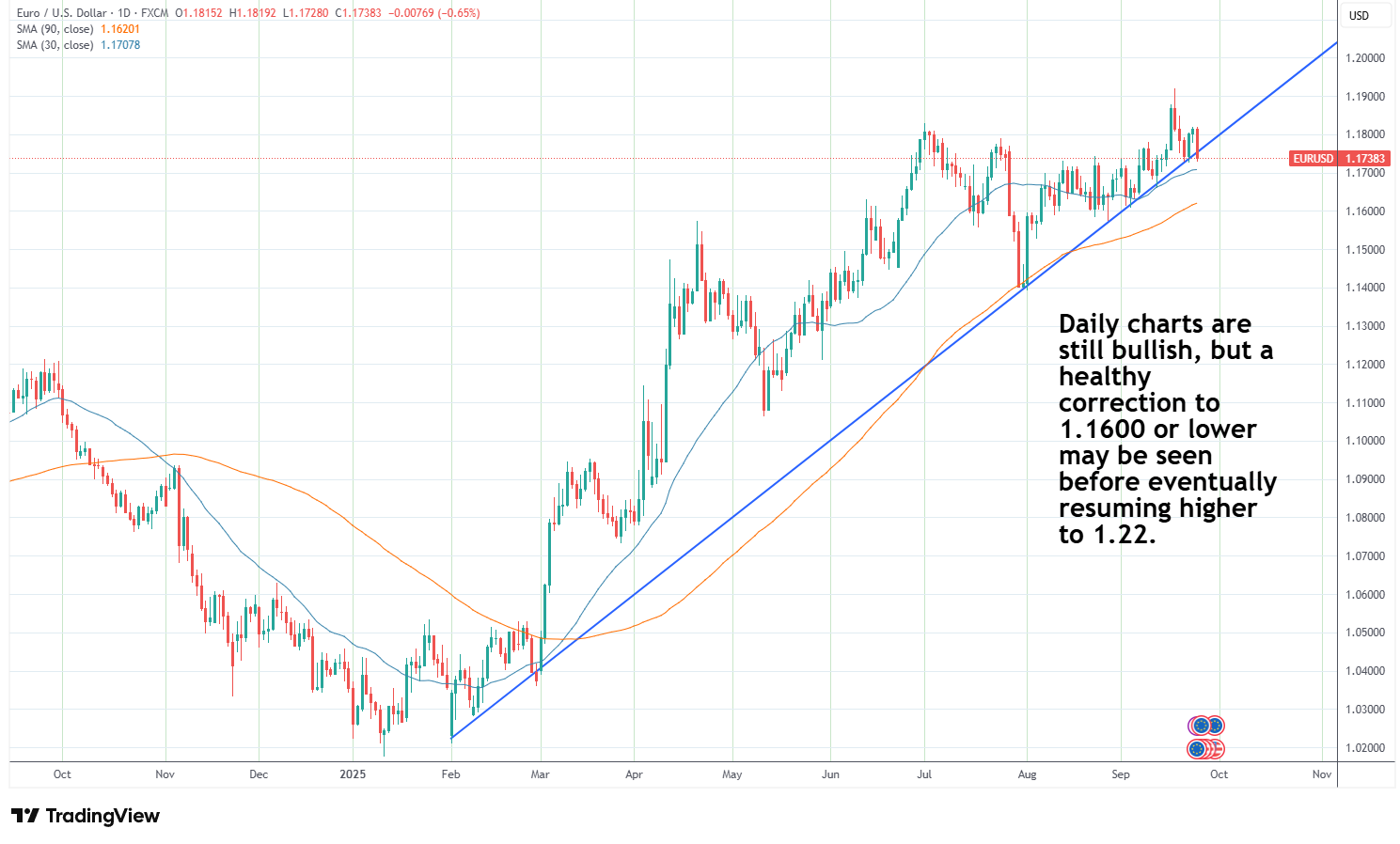
After the FOMC cut rates in September by 25 BP, EUR/USD broke above 1.19 for the first time in exactly four years. Russia first started mobilizing tanks on the Ukraine and Crimea border in March of 2021, which led to the first wave of Euro selling versus the dollar that year when Euro was trading at 1.21. After the February 2022 invasion, the Euro ultimately sold off to .9550 and has been in a recovery since. The Eurozone has been ahead of the U.S. in its rate-cutting cycle and experiencing low growth and an increase in tariffs on goods. The approach by ECB President Christine LaGarde is expected to be cautious and data driven going forward with inflation now more under control. The U.S. is expected to do two more cuts this year and possibly one more early in 2026, which will keep pressure on the dollar selling. Unless there is a severe U.S. downturn or global crisis to create flight into dollars, we could see the Euro trade to 1.22 by year-end. Downside support is now at 1.16 and 1.14, which would need to break to reverse a weak dollar bias.
GBP/USD
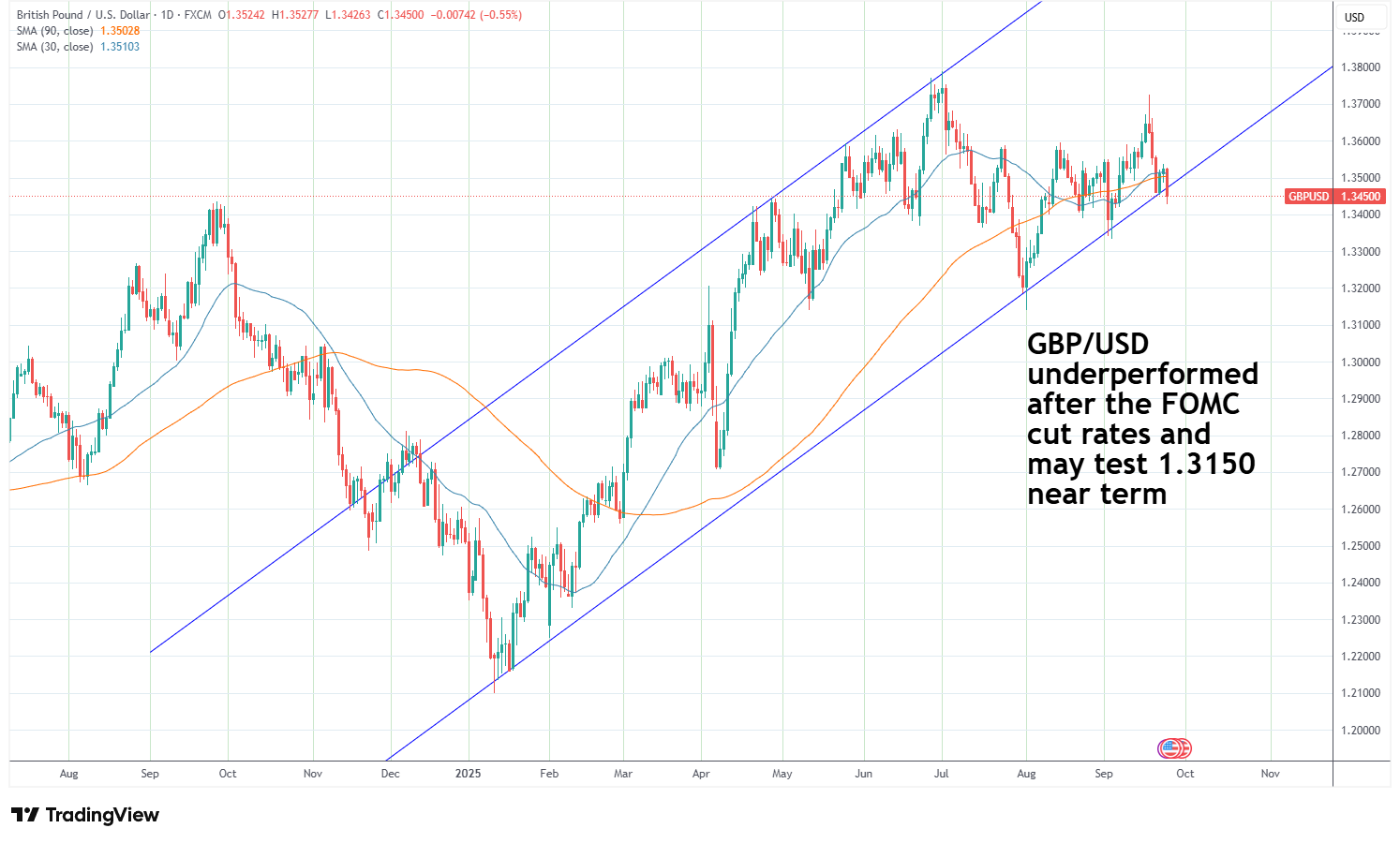
The Bank of England opted for a no rate cut at the September meeting by a 7-2 margin, keeping rates at 4%. The Consumer Price Index remains stubbornly high at 3.8% while the GDP hovers between 0 and 1% and job growth remains low. President Trump and Prime Minister Keir Starmer met in September to discuss a range of business issues along with immigration, Gaza and Ukraine. Starmer failed to get Trump to lower tariffs on steel and aluminum but made some headway on British autos and aerospace. GBP did not make yearly highs against the dollar like EUR did in September after the FOMC cut rates and could be setting up for a test of downside support near 1.3150. Weekly support is much lower at 1.2925 and that would have to be taken out to stop the upward trend.
USD/JPY
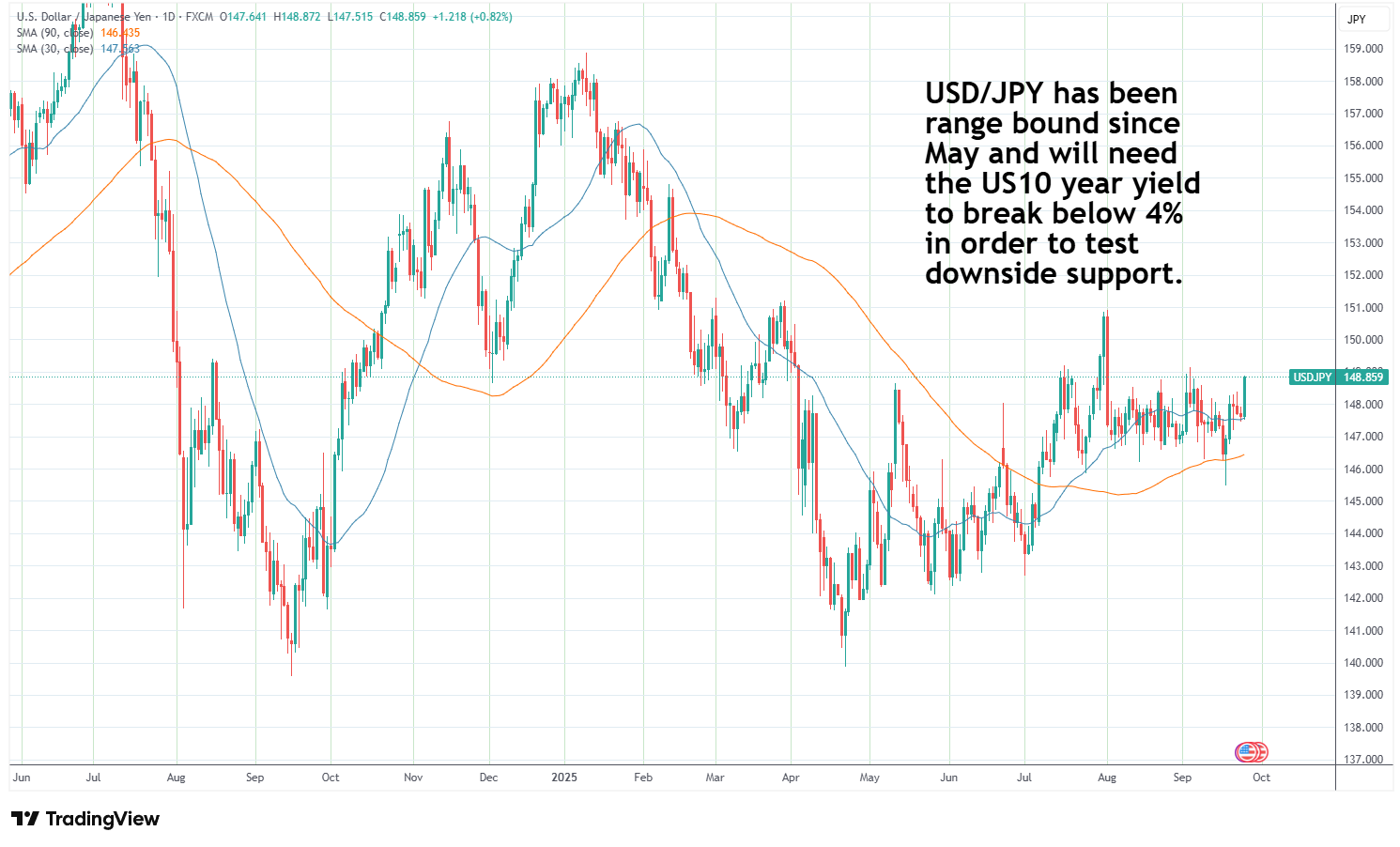
Inflation has risen modestly so the Bank of Japan voted 7-2 to keep rates steady. Japan would like to see the yen stronger overall, but it is content with the U.S. cutting rates to achieve this and protecting a USD/JPY exchange rate above 160. Japan has seen moderate growth but still suffers from long-term structural issues, such as an aging population and low birth rates. Japan, unlike the other G7 countries, have not imported immigrants globally to supplement a cheap labor base. Since Trump initiated tariffs globally, USD/JPY has been contained between the 140-150 range. With more Fed cuts coming this year, the downside may be more vulnerable, especially as bond yields trend lower.
USD/CAD
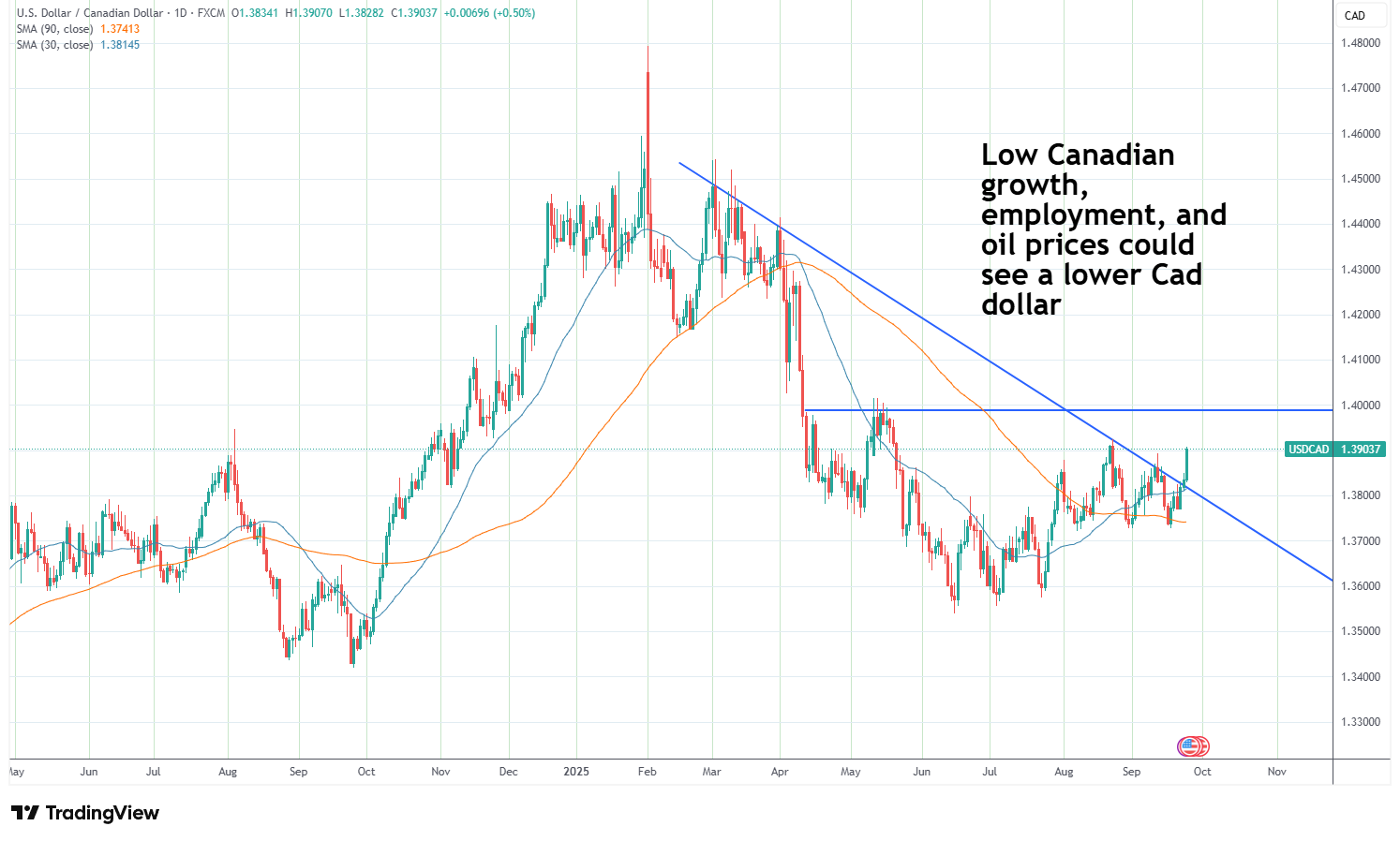
The Bank of Canada cut rates 25 BP as growth and employment both point to a fragile and slowing economy. GDP dropped by 1.6% in the second quarter and exports dropped 27% due to U.S. tariffs. Canada dropped a whopping 65,000 jobs while the unemployment rate spiked to 7.1%. The inflation rate remains under 2%, which will pave the way for future rate cuts. Canada’s main export is oil. It has suffered as prices have declined since Trump has been in office and promised to expand supply. USD/CAD after having extreme volatility when Trump implemented tariffs globally, has been range bound since May. Lower oil prices and more Bank of Canada rate cuts could see a weaker Canadian dollar into year-end. Trend resistance is now above 1.400.
Important disclosure information
Asset allocation and diversifications do not ensure against loss. This content is general in nature and does not constitute legal, tax, accounting, financial or investment advice. You are encouraged to consult with competent legal, tax, accounting, financial or investment professionals based on your specific circumstances. We do not make any warranties as to accuracy or completeness of this information, do not endorse any third-party companies, products, or services described here, and take no liability for your use of this information.