
Learn

- Share:
-

-

-

-


The Penny Is Being Phased Out: Here's What It Means for Consumers
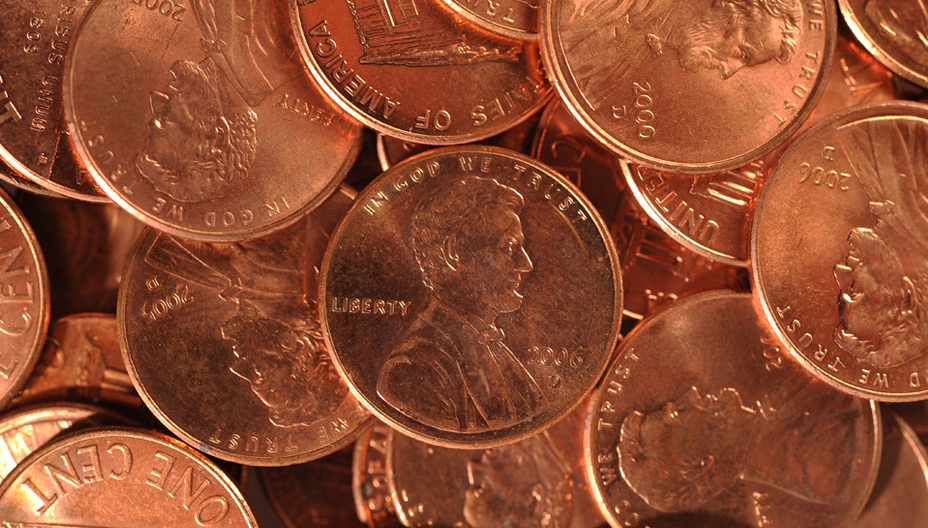
On November 12, 2025, the United States Mint produced its last penny, ending a 232-year production run.1 While the penny will remain legal tender in the U.S. — and companies will be allowed to price items in one cent increments — there won't be any more pennies print. Ever.
Why is that? In a nutshell, cost. The U.S. Mint reports that, over the past decade, the cost of producing a penny has soared from 1.42 cents to 3.69 cents. With cash payments falling due to online shopping — coupled with increased use of credit card and digital wallets for in-store purchases — why spend so much money continuing to make and distribute pennies?
Check out answers to common questions about the penny situation below.
Will the Penny Be Disappearing?
Not exactly. You won't stop seeing the iconic penny any time soon. U.S. Treasurer Brandon Beach said an estimated 300 billion pennies remain in circulation.2
Well, theoretically in circulation. In reality, the penny doesn't circulate all that much — especially compared to its hefty, valuable older sibling, the quarter. Consider this Federal Reserve System data from 1995: While the circulation rates for quarters was 88%, it was only 34% for pennies!3
According to the data, "These numbers tell us that for almost two-thirds of the billions of pennies produced, the trip from the Mint to the Federal Reserve to the commercial banks and finally to consumers is a 'one-way trip' — they are never again seen in circulation."3
And that was before the days of online shopping, expanded credit card use and digital wallets!
No one can say for sure where all the "missing" pennies are. Tucked away in jars and piggy banks? Accidentally thrown away or lost outside? Eaten out of pants pockets by rogue dryers? Wherever these missing pennies are, the point is that without the Federal Reserve minting new pennies, there will increasingly become penny shortages.
Why Should Consumers Care?
Without new pennies being minted, banks can't order extra pennies.4 So, if a bank doesn't have pennies, they don't have pennies — even if local businesses need pennies to make change for cash-paying customers.
The upshot: Businesses may lack the pennies they need to make proper change for cash-paying customers.
What Can Consumers Expect?
Unlike when other countries, like Canada, have phased out their smallest coins, the federal government has provided retailers with little guidance on how to handle the coming penny shortage.5 Should they always round down to the nearest nickel? Should they round down for prices ending in 1, 2, 6, and 7 — and up for prices that end in 3, 4, 8, and 9? And would they do that only for cash-paying customers or for everyone, regardless of payment method?
This has left businesses to figure it out on their own. Here are some ways businesses might respond to increasing penny shortages:
- Round off to nearest nickel. Prices ending in a 3, 4, 8, or 9 would be rounded up for cash-paying customers, while prices ending in a 1, 2, 6 or 7 would be rounded down. So if you were paying cash for a purchase of $7.08, you'd pay $7.10, while you'd only pay $7.00 if the total was $7.02. This is what McDonald's said it would be doing — but only if it has a localized penny shortage.6
- Round down to the nearest nickel, no matter what. So that $7.08 purchase would only cost $7.05 if you paid cash, while a purchase of $7.03 would only cost $7.00.
- Encourage you to start use non-cash payment method (like credit card, debit card, etc.) or pay with exact change.
- Stop accepting cash as a payment option. According to the Federal Reserve, there is no federal law mandating businesses to accept cash payments.7 However, some states and municipalities may have laws requiring certain types of businesses to accept to cash.
- Offer you the option to round up to support a selected charity.
- Incentivize you to use pennies. Consider this offer at a Sheetz convenience store in south-central Pennsylvania: "Cash in one dollar's worth of spare pennies to receive a self-serve drink."8
How Can Consumers Prepare?
If you usually use non-cash payment methods, you likely won't notice any changes. But if you typically pay with cash — or if you've stepped back from using credit cards to avoid incurring debt — you may want to rethink your payment strategies.
Be Ready With Exact Change If Possible
Keep pennies in your wallet to use — perhaps only for places that are unable to make change.
Explore Non-Cash Payment Methods
Maybe you don't have a non-cash way to make a payment. Maybe you're reluctant to use credit card for fear of racking up debt. Or maybe you're reluctant to use a debit card for fear of fraud.
In these cases, what are you options?
Prepaid credit card. These function like a credit card when you make a payment, but you can only spend money that you've already loaded onto the card. This can help you stick to a budget. It also separates your personal banking information from the transaction, limiting your exposure to fraudsters.
Digital wallet. A digital wallet is where you download a digital app — like Apple Pay®, Cash App, Google Pay™, Venmo, Zelle®, or Samsung Pay9 — onto your phone and then securely store your payment info, like a credit card. When you pay, the app sends the merchant a one-time token instead of your financial info, enhancing your safety.
Don't have a credit card? Most digital wallets will allow you to use a debit card instead of a credit card. This will allow you to make a debit card transaction without sharing your debit card info with the merchant — or with fraudsters, who can sometimes find clever ways to steal your debit card info during a transaction.
Get Ready to Take Advantage of Unique Offers
Until there is a sustainable long-term plan for how to handle the penny phase-out, you may be able to find a unique deal in exchange for paying with pennies — or cashing your pennies in at a local store.
So, empty those piggy banks and old jars filled with change. Just be sure to save a few pennies to show off to your grandkids some day!
Important disclosure information
This content is general in nature and does not constitute legal, tax, accounting, financial or investment advice. You are encouraged to consult with competent legal, tax, accounting, financial or investment professionals based on your specific circumstances. We do not make any warranties as to accuracy or completeness of this information, do not endorse any third-party companies, products, or services described here, and take no liability for your use of this information.
- United States Mint, "United States Mint Hosts Historic Ceremonial Strike for Final Production of the Circulating One-Cent Coin," published November 12, 2025. Accessed November 18, 2025. Back
- Mike Snider and Phaedra Trethan, "The last pennies were minted. The special coins will be auctioned in the future," USA TODAY, published November 12, 2025. Accessed November 19, 2025. Back
- United States General Accounting Office, "FUTURE OF THE PENNY Options for Congressional Consideration," published July 16, 1996. Accessed November 18, 2025. Back
- Ken Sweet, "Banks and retailers run short on pennies as the US Mint stops making them," AP. Updated October 30, 2025. Accessed November 18, 2025. Back
- Dylan Jeon, "U.S. penny shortage has retailers scrambling to adapt cash transaction policies," National Retail Federation. Published October 29, 2025. Accessed November 18, 2025. Back
- Mike Snider, "McDonald's hit by penny shortage, rounds cash transactions to a nickel," USA Today. Updated October 31, 2025. Accessed November 18, 2025. Back
- Board of Governors of the Federal Reserve System, "Is it legal for a business in the United States to refuse cash as a form of payment?" Updated July 21, 2020. Accessed November 18, 2025. Back
- Rachael Lardani, "Sheetz in Pa. asking customers to use cashless payments or round up due to penny shortage," 8WGAL. Updated October 9, 2025. Published November 18, 2025. Back
- Louis Thompsett, "Top 10: Digital Wallets," FinTech Magazine, published May 1, 2025. Accessed January 26, 2026. Back
Do you have questions or ideas?
Share your thoughts about this article or suggest a topic for a new one