
Improving Customer Experience to Drive Revenue Growth

Consumers continue to expect personalized, fast and seamless interactions across every touchpoint. Customer experience (CX), however, is no longer simply a service initiative — it’s a revenue generator.
Recent research demonstrates customer experience directly impacts revenue growth, loyalty, repeat purchases and competitive performance. Forrester found that customer-obsessed organizations achieved 41% faster revenue growth, 49% faster profit growth and 51% better customer retention than their peers.1 In the same report, Forrester revealed only 3% of respondents are hyperfocused on customer needs at a time when CX quality is declining.2 That gap presents a clear opportunity for companies to make customer needs central to every interaction and differentiate themselves from competitors.
These findings underscore why improving CX is not just a service priority, it’s a competitive growth strategy.
Customer satisfaction drives loyalty, trust and repeat purchases.
According to Qualtrics data, customers are 400% more likely to recommend, 400% more likely to trust and 250% more likely to purchase more when they are satisfied with their experiences.3
Corporations that understand how to improve customer satisfaction can transform everyday interactions into measurable business value.
Understand what your customers want and deliver satisfying experiences.
Improving customer experience begins with understanding how customers interact with your organization from awareness to post-purchase support.
Gather customer insights.
Understanding what customers want enables companies to deliver on these desires at every point in the buyers’ journey. Ask targeted questions about customer goals, product preferences, buying habits, service expectations, preferred channels and pain points. The more questions you ask, the more you’ll understand customer behavior. Companies can strengthen customer loyalty, increase repeat purchases and support long-term revenue growth when they meet customer expectations.
Predictive analytics, a strategic application of data collection, enables corporations to identify issues before they arise. In this way, organizations can prevent churn while increasing revenue opportunities.
Data insights and analytics benefit the entire enterprise. Cascade customer insights throughout the organization, including marketing, sales, customer service, finance, product development, operations, IT, compliance and executive leadership. This ensures every team is using the same customer insights to make smarter decisions, reduce friction and deliver more consistent experiences that strengthen loyalty and revenue growth.Map customer touchpoints.
Journey mapping helps companies pinpoint how customers make decisions across each touchpoint. It enables marketers to deliver more relevant messages, offers and experiences that align with customer needs and increase conversion rates. Corporations should map every touchpoint along the customer journey to deliver a consistent experience across all channels. These experiences include website visits, sales and customer service calls, online purchases, onboarding, billing, tech support and renewals.
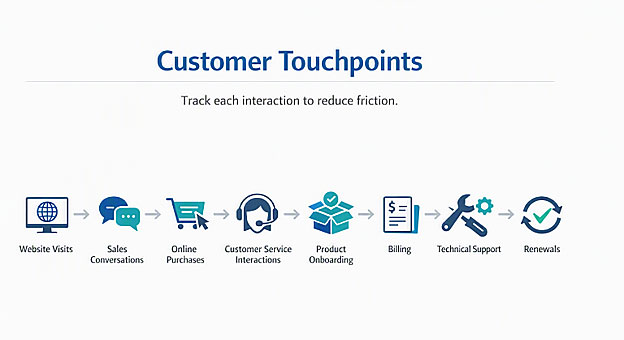
Create seamless, personalized experiences with every customer interaction.
Customers expect companies to recognize their preferences and deliver relevant experiences. Seventy-six percent of buyers expect personalization.4
Strategically applying customer data enables organizations to personalize product recommendations, marketing campaigns, website experiences, email communications, loyalty offers and customer support. The rewards are great for those who get it right — personalization can increase revenue by 15-20% for companies with well-executed strategies.5Improve service speed and reduce customer effort with AI.
AI can accelerate service, support more personalized interactions and strengthen business, helping companies improve CX. Organizations that combine AI with skilled customer support teams often reduce response times while reducing customer effort and improving satisfaction.
Modern AI solutions can streamline service, anticipate customer needs, recommend products and equip agents with real-time information. Practical examples include instantly answering routine questions, routing requests to appropriate departments and providing agents with real-time data, as well as analyzing customer sentiment.
According to Zendesk, leading companies in human-centered AI report 33% higher customer acquisition, 22% higher customer retention and 49% higher cross-sell revenue.6 Ninety-seven percent of Zendesk’s customers who adopted this approach reported a positive ROI over 12 months.7Build trust through transparency.
Trust is one of the strongest drivers of customer loyalty. Corporations benefit from clearly communicating pricing, shipping, service delays, data privacy, product availability and return policies. Transparent communication builds long-term relationships while reducing dissatisfaction.Continuously measure customer feedback.
Successful organizations never assume they know what customers want; instead, they actively collect feedback. Surveys, online reviews, Net Promoter Scores, Customer Satisfaction and Customer Effort Scores help organizations measure satisfaction, identify problems and prioritize improvements. In addition, social media monitoring and website analytics help organizations understand customer behavior and identify emerging issues.
Listening and acting on customer feedback demonstrates that organizations value customers' opinions.Measure business outcomes.
Customer experience initiatives should connect directly to measurable business results. Key performance indicators such as Customer Lifetime Value, customer retention rates, average resolution times, repeat purchase rates, revenue per customer and churn rates help organizations evaluate progress. Tracking these metrics demonstrates how CX investments contribute to stronger financial performance.
Customer experience drives revenue growth and competitive advantage.
Exceptional customer experience can increase retention, repeat purchases, average transaction values, referrals and profitability while improving efficiency and reducing service costs. When corporations treat CX as a growth engine, they can build trust, encourage loyalty and create advocates who support sustainable revenue growth.
As competition intensifies, customer experience is becoming a critical differentiator. In 2026, 89% of businesses will compete primarily on CX, making this discipline essential for standing out beyond price and product.8
We help clients strengthen customer relationships and drive long-term revenue growth. For more details, talk to a Synovus banker or complete a short form and a representative will contact you. You can also stop by one of our local branches.
Operations
How to Ensure Resilient Financial Operations During Crises
Operations
Business Resilience Guide: Effective Continuity Planning to Mitigate Disruptions
Operations
Unlocking Revenue Growth with Data-Driven Decision-making
-
Interest Rate News: Third Quarter 2026
Fed rates held steady in Q2 as inflation remained elevated. See what market volatility and term borrowing trends could mean for borrowers in Q3 2026.
-
Interest Rate News: Second Quarter 2026
Get Q2 2026 FOMC rate updates, forecasts and market insights. Also see how interest rate changes impact loans, mortgages, and business growth strategies.
Important disclosure information
This content is general in nature and does not constitute legal, tax, accounting, financial or investment advice. You are encouraged to consult with competent legal, tax, accounting, financial or investment professionals based on your specific circumstances. We do not make any warranties as to accuracy or completeness of this information, do not endorse any third-party companies, products, or services described here, and take no liability for your use of this information.
- Forrester, “Forrester’s 2024 US Customer Experience Index: Brands’ CX Quality is at an All-Time Low,” June 17, 2024 Back
- Ibid Back
- Qualtrics, “Customer Experience Trends Report,” 2026 Back
- Zendesk, “92 Customer Service Statistics You Need to Know in 2026,” January 13, 2026 Back
- Worldmetrics, “Personalized Marketing Statistics,” 2026 Back
- Zendesk, “Zendesk 2025 CX Trends Report: Human-Centric AI Drives Loyalty,” November 20, 2024 Back
- Zendesk, “Zendesk CX Trends 2026: Leading in the AI Era,” 2026 Back
- OnRamp, “Customer Experience Statistics: What the Numbers Reveal for CX in 2026” March 30, 2026 Back