
Crop Farming Faces Rising Costs, Weather Risks and Mixed Growth in 2026

U.S. crop production remains a vital part of the economy, but inflation is increasing operating costs and making crop production more difficult and less profitable. USDA forecasts total farm production expenses will reach $477.7 billion in 2026, up $4.6 billion from 2025, highlighting the cost pressures growers face.1
For 2026, the USDA predicts net farm income at $153.4 billion, down 0.7% from 2025 in nominal dollars and down 2.6% after adjusting for inflation. Even with the expected decline, the agency notes that inflation-adjusted net farm income would remain above its 20-year average.2
The picture is mixed for crop farming.
Cash crop receipts are declining as farm costs and market shifts rise.
U.S. cash crop receipts declined approximately 8.5% - 9% since 2023. Commodity pricing adjustments from high to moderate, while production costs remain elevated — forced the decline. For example, receipts for major crops such as corn, soybeans and cotton weakened in 2023 after strong market conditions in 2022. Since then, growers continue to manage high input, equipment, labor and financing costs which is lowering margins even when production is steady.
Uneven demand, global supply shifts and weather volatility are also impacting cash crops. Oversupply can weigh on prices for crops such as peanuts, while lower sales expectations affect crops such as wheat. At the same time, droughts, flooding and extreme temperatures can disrupt yields and create uncertainty throughout the growing season. Recent U.S. conditions underscore that risk: as of June 30, 2026, nearly half of the Lower 48 states were experiencing drought, even as heavy rain brought pockets of flash flooding from the Plains into the Ohio and Tennessee Valleys.3 These weather events can affect yields, prices and cash flow throughout the growing season.
Together, these conditions are reducing the value of cash crop receipts and making profitability more difficult to maintain. The USDA forecasts total crop cash receipts at $240.8 billion in 2026, up 1.2% from 2025 in nominal dollars. However, after adjusting for inflation, crop cash receipts will decline 0.7%.4
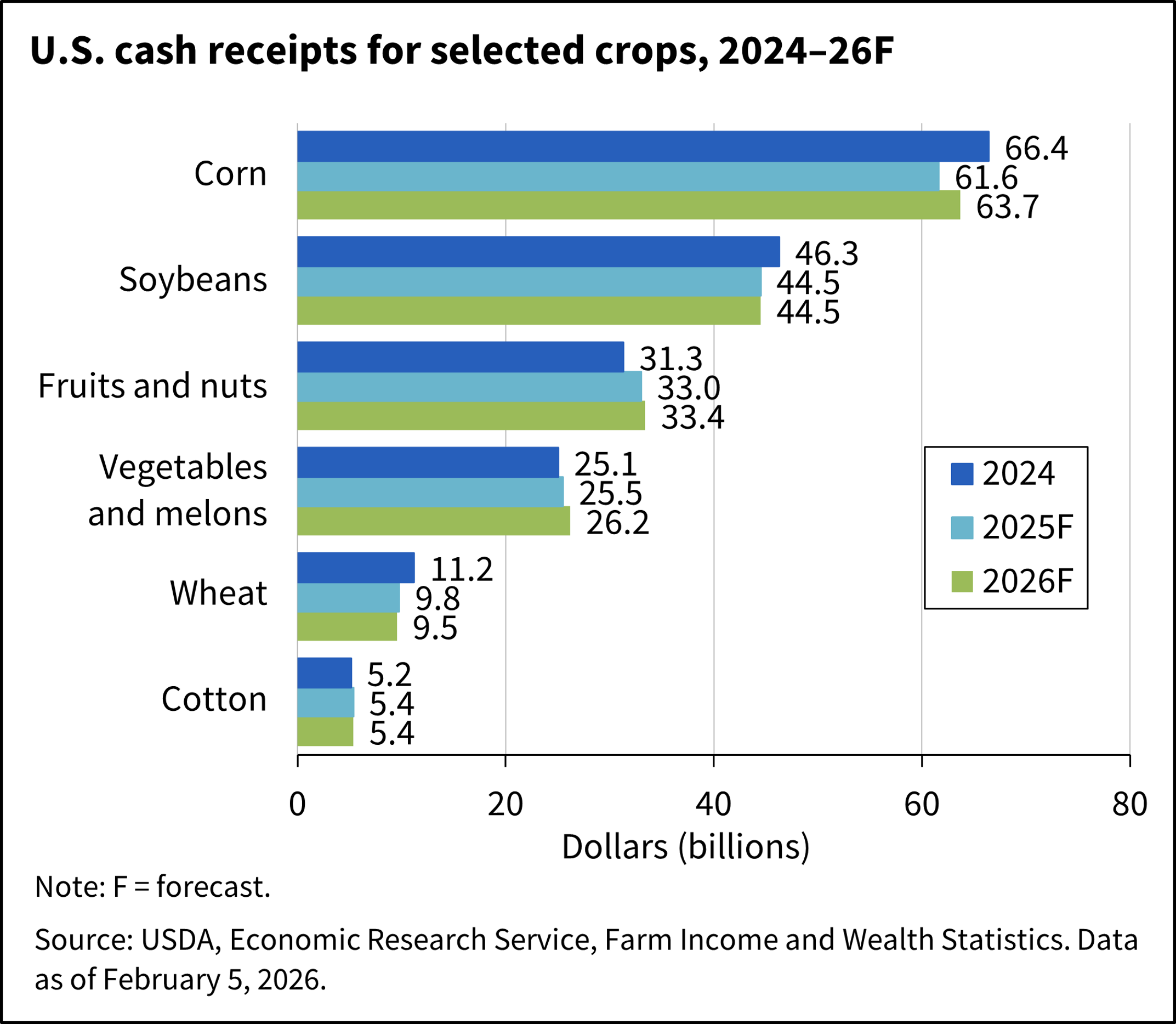
The outlook varies by crop. The USDA predicts feed crops, such as corn and hay will rise, while human food crops wheat and rice receipts will decline. Soybean and cotton receipts will likely remain near 2025 levels.5 Growers’ decisions about planting, equipment, labor and financing often happen well before harvest and months before prices, yields and weather conditions are clear.
Southeastern growers play a vital role in U.S. crop farming.
The Southeast’s mild climate and long growing season make the region well suited for crop farming. Growers across the region contribute to major farm crops, specialty crops and food production.
- Soybeans. U.S. soybean production declined in 2025, even as average yield reached a record high. Soybean receipts will stay near 2025 levels in 2026.6 Though soybeans are relatively inexpensive to grow compared to some farm crops, pricing pressure, drought and global supply conditions can affect production and profitability. Tennessee, Georgia, Alabama, North and South Carolina growers will feel the impact.
- Corn. The U.S. is the world’s largest corn producer, consumer and exporter. According to USDA research, U.S. corn production reached a record high in 2025 but will be lower in 2026. The agency expects corn receipts to increase in 2026, mainly because farmers will sell higher quantities.7 Most U.S. corn is grown in the Heartland, but Southeastern states Kentucky, Tennessee, North Carolina and Georgia also contribute to crop production. These four states will contribute 3%-4% of U.S.-grown corn.8
- Wheat. U.S. wheat production was relatively steady in 2025. USDA expects wheat receipts to fall in 2026 because of lower sales.9 The softer outlook creates additional challenges for growers already managing weather risks, input costs and shifting demand. North Carolina is the largest wheat producer in the Southeast. Along with Arkansas, Tennessee, Georgia and Mississippi, North Carolina will contribute 4%-5% of the nation’s wheat in 2026.10
- Peanuts. The Southeast’s extended growing season favors peanuts, and Georgia remains a leading producer. In 2025, Georgia growers harvested 915,000 acres of peanuts and produced about 3.7 billion pounds.11 Georgia will remain as lead producer of this farm crop in 2026. Alabama and Florida are also among the top four states, including Texas. However, oversupply could keep peanut prices around $375-$450 per ton without stronger demand and new markets.12
- Pecans. Pecans remain an important specialty crop in the region, with Georgia producing approximately a third of the nation’s crop historically. Producers and importers continue to support the American Pecan Promotion Board’s research and promotion program, which is intended to strengthen the nut’s market position.
- Cotton. Though it’s not among food crops, cotton is an important commodity. The fiber is used for clothing and textiles, as well as protein for livestock. Georgia is the second highest U.S. cotton producer after Texas. Georgia farmers expect to harvest around 830,000 acres of cotton from 2025 plantings, which is equivalent to 1.7 million bales. It’s the lowest production in 10 years and will impact seed companies and suppliers.13
Southeastern growers support key U.S. crops, but the 2026 outlook is mixed. Corn and soybeans appear relatively stable, while wheat, peanuts and cotton face challenges from lower sales, oversupply, weather risks and shifting demand. Addressing these challenges is essential to protect the traditional cash crops that remain a vital source of income for Southeastern growers, local economies and the broader agricultural supply chain.
Crop farming requires ongoing investment to manage rising costs.
Like every other business, crop farming requires experience, planning and the ability to adjust when conditions change. Farmers and other agricultural producers must manage shifts in pricing, supply and demand, along with weather, labor availability, equipment costs and commodity prices. Such pressures drive up costs during the growing season and reduce profitability after harvest. Careful cash flow management and timely access to capital remain critical. Learn more about how Synovus Agriculture Banking can help.
Market and Industry Insights
Interest Rate News: Third Quarter 2026
Market and Industry Insights
Interest Rate News: Second Quarter 2026
Market and Industry Insights
Expert Financial Strategies for Public Schools and Colleges Facing Rising Costs and Enrollment Declines
-
Interest Rate News: Third Quarter 2026
Fed rates held steady in Q2 as inflation remained elevated. See what market volatility and term borrowing trends could mean for borrowers in Q3 2026.
-
Interest Rate News: Second Quarter 2026
Get Q2 2026 FOMC rate updates, forecasts and market insights. Also see how interest rate changes impact loans, mortgages, and business growth strategies.
Important disclosure information
This content is general in nature and does not constitute legal, tax, accounting, financial or investment advice. You are encouraged to consult with competent legal, tax, accounting, financial or investment professionals based on your specific circumstances. We do not make any warranties as to accuracy or completeness of this information, do not endorse any third-party companies, products, or services described here, and take no liability for your use of this information.
- USDA Economic Research Service, “Farm Sector Income Forecast,” May 19, 2026 Back
- USDA Economic Research Service, “Highlights from the Farm Income Forecast,” May 7, 2026 Back
- U.S. Drought Monitor, “Current Map,” July 2, 2026 Back
- USDA Economic Research Service, “Farm Sector Income Forecast,” May 19, 2026 Back
- Ibid Back
- Ibid Back
- USDA Economic Research Service, “Farm Sector Income Forecast,” May 19, 2026 Back
- Ibid Back
- USDA, “Wheat Outlook 2026: U.S. Hard Red Winter Crop at 69-Year Low,” June 15, 2026 Back
- Substack, “Signing Off on the 2026 Wheat Crop-The Plains Buckle, the Nation Bends,” June 5, 2026 Back
- USDA, “National Agricultural Statistics Service, “2025 State Agriculture Overview: Georgia,” July 8, 2026 Back
- University of Georgia, College of Agriculture and Environmental Sciences, “2026 Peanut Outlook and Market Situation,” February 13, 2026 Back
- University of Georgia, College of Agriculture and Environmental Sciences, “2026 Cotton Outlook and Market Situation,” January 23, 2026 Back